Is AI Vibe Coding Creating a 'Pay-to-Play-or-Perish' Model?
The gap between those who can afford AI development tools and those who cannot seems to be rapidly increasing. Access to LLMs and supporting tools that automatically generate application code and supporting virtual infrastructure is quickly become more expensive. But, if you don’t pay for them, what are your options? It seems that, unlike in the past where you always had free-tier options to help you compete, Vibe Coding doesn’t seem to offer such free options.
Author: Frank Guerino, Guerino Enterprises, LLC
Category: Artificial Intelligence · Technology Access · Industry Analysis
Overview
When I moved from free AI tiers to Pro subscriptions, the productivity gains were immediate and significant. When I took the plunge into Vibe Coding - with a new AI-enhanced IDE, expanded monthly AI capacity, and accumulating token charges - the cost escalated faster than I anticipated and the choice became binary: keep investing or stop advancing. That experience prompted a broader question. My situation is not unique, but my ability to absorb the cost is. For millions of developers in lower-income markets, for early-career engineers, for small organizations without enterprise budgets, the same binary choice lands very differently. This article explores whether AI Vibe Coding is creating a structural ‘Pay-to-Play-or-Perish’ dynamic - one in which access to premium tools determines not just productivity but career trajectory and organizational competitiveness. It engages honestly with the counterargument that AI democratizes capability, examines who is most at risk, and asks what the consequences are - at individual, organizational, and national scale - when an entire generation of talented developers cannot afford to pay.
Not long ago, software development was one of the most accessible high-skill professions on the planet. A curious teenager in any part of the world with a second-hand laptop and a reliable internet connection could learn to code, build something real, and compete. The tools were mostly free. The knowledge was abundant. The barrier was talent, discipline, and time - not money.
That’s changing. And it’s changing faster than most people realize.
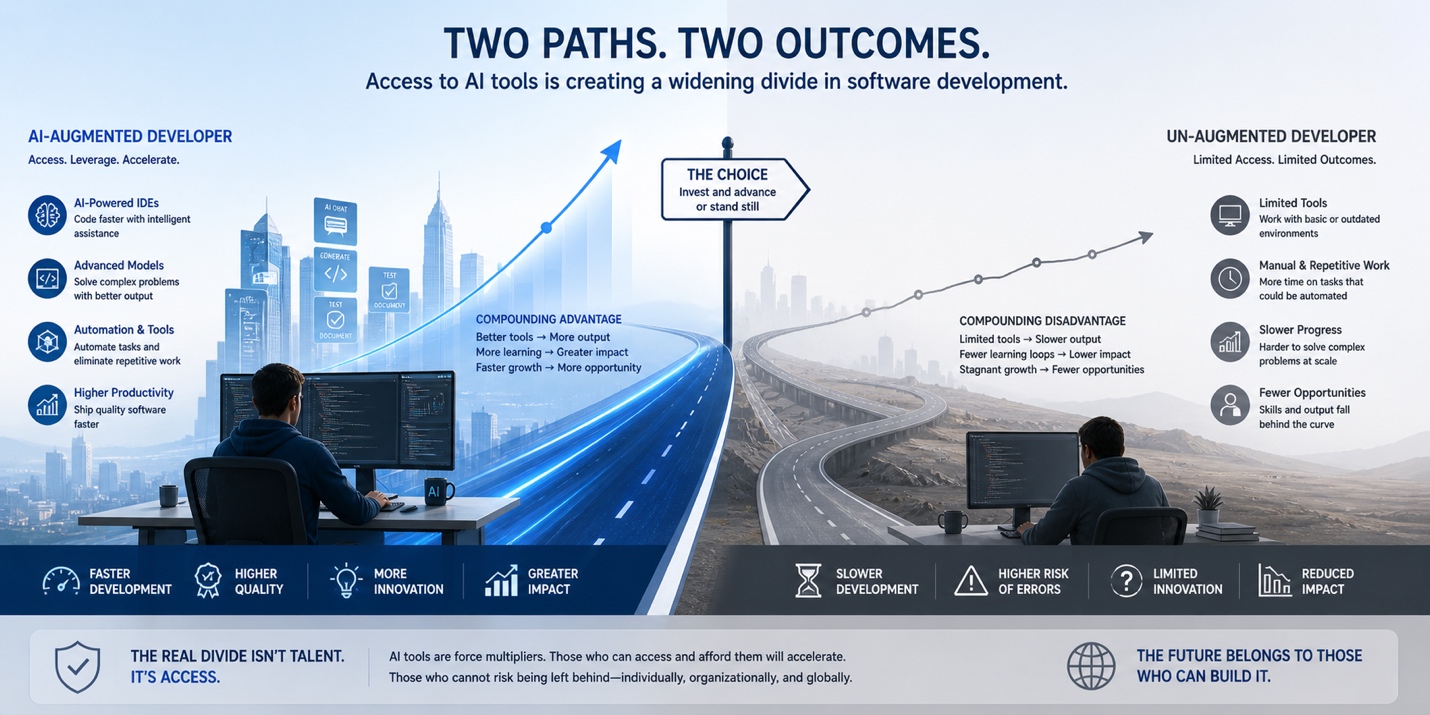
The emergence of AI-assisted development - often called Vibe Coding, where developers use AI tools to generate, refine, and reason about code through natural language - is producing a new kind of professional divide. On one side are developers with access to a growing stack of powerful, expensive AI tools. On the other are developers who are working without them - not because they lack the intelligence, the curiosity, or the drive, but because they cannot afford the subscriptions.
This raises a question that I think the technology industry has not yet grappled with seriously enough: Is AI Vibe Coding creating a ‘Pay-to-Play-or-Perish’ model? And if it is, what does that mean for the developers, the organizations, and the economies that cannot pay?
My Own Journey Into the Vibe Coding Model
I want to be transparent about something before making the broader argument: I have lived this progression personally. My own journey into AI-assisted development was methodical, incremental, and ultimately eye-opening about how quickly the cost of staying competitive can escalate.
It started, as it does for most developers and engineers, with free tiers. I used the free versions of the major AI tools for research - exploring concepts, generating initial drafts, asking questions that would previously have required hours of reading. The free tiers were genuinely useful. They changed how I worked. They showed me what was possible. And for a while, they were enough.
Then the complexity of what I wanted to do outgrew what the free tiers could reliably support. One of the key drivers was my need for truly exceptional generative capabilities (i.e., software code generation) - specifically for complex document and interactive visualization generation that would have taken me days or weeks to produce manually. But one capability that genuinely stunned me was what the Pro-tier tools could do with complex spreadsheets. Creating and manipulating multi-tab workbooks with intricate formulas, cross-worksheet linkages, and structured data relationships became an amazing breeze. Work that would have consumed days or weeks to build out a carefully linked, formula-driven spreadsheet from scratch was suddenly happening in minutes, accurately, and with a level of structural sophistication I might not have achieved on my own without significant trial and error. I saw time savings that were not incremental but, instead, transformational. So, I moved to Pro subscriptions that were approximately $20 per month per tool to reliably access these capabilities for everyday work. The jump was significant and the $20 per month felt like an obvious and fruitful professional investment, not unlike a software license I might have purchased without question in a previous era.
Then I decided to take the plunge into Vibe Coding - using AI tools not just to assist my thinking but to actively generate, refine, and reason about code through natural language. And that decision changed the financial picture in ways I had not fully anticipated.
To Vibe Code seriously, I needed an AI-enhanced IDE (e.g., Cursor). That was another $20 per month. My existing AI capacity was immediately insufficient - the volume of context, generation, and iteration that serious Vibe Coding demands hit the limits of a standard Claude Pro subscription hard and fast. I upgraded my monthly AI capacity to $100 per month. And on top of that, Claude Code token utilization charges began accumulating as the complexity of my sessions grew. Every ambitious project pushed me further into consumption territory that the flat monthly fee did not cover. And, what’s worse is that token utilization costs are not clearly predictable. One week they could be a few dollars while other weeks they could be hundreds of dollars. And, while AI providers offer token utilization caps to help control your costs, hitting them puts you in the binary choice situation of buying more token capacity or find a way to do less coding over longer periods of time to spread your costs throughout the year.
The moment that crystallized the pay-to-play dynamic for me was not a single large bill. It was the realization that I was facing a binary choice: either I continue buying into the tools and keep advancing in Vibe Coding complexity, or I stop spending and stop advancing. There was no middle path. The tools that enable serious Vibe Coding are not substitutable at the capability level by free alternatives - not yet, and not for the kind of complex, sustained, iterative work that real projects require.
I made the decision to keep investing. I’m fortunate that I have the means to do so. But as I worked through that decision, I kept thinking about the developers who face the same binary choice and do not have the same financial flexibility; especially younger generations. For them, the choice is not about professional priority. It is about whether access to the ride is paid for. And that is a very different kind of decision, because without paying for the ride, you’re essentially stranded.
The Real Cost of Vibe Coding (as of April, 2026)
To understand the scale of the access problem, it helps to look at what a developer actually needs to Vibe Code competitively today. The core tooling stack looks something like this:
-
An AI-enhanced IDE - Cursor Pro, for example, runs approximately $20 per month. It is significantly more capable than free alternatives.
-
A premium large language model subscription - Claude Pro, ChatGPT Plus, or equivalent - typically $20 per month each. Heavy API usage can push this to $100 or more monthly.
-
A coding assistant plugin - GitHub Copilot runs $10 to $19 per month.
-
Supplementary research and reasoning tools - Perplexity, Gemini Advanced, and others add another $20 to $40 per month for serious professional use.
At the low end, a developer building a minimal viable AI-augmented workflow is looking at $70 to $100 per month. At a professional level, $150 to $250 per month is not unusual, and that is before touching cloud infrastructure costs for the applications being built.
For a developer working in San Francisco or London, this is a manageable expense. For a developer in Lagos, Karachi, Manila, or Chisinau - where developer salaries may be a fraction of their Western counterparts - this monthly cost can represent a significant portion of their income. For students, for independent developers early in their careers, and for small startups without enterprise budgets, it is a genuine barrier.
Free tiers exist, and I want to be fair about this. OpenAI, Anthropic, and others offer limited free access to their models. Open-source alternatives - Ollama, Llama, Mistral, and others running on local hardware - are genuinely capable and improving rapidly. These options matter. But, in fairness, they are not at all equivalent to the premium tools in capability or in the developer experience they enable. The free tier is real but the significant capability gap is also real.
The Widening Productivity Gap
My opinion is that the more consequential problem is not the subscription cost in isolation but the compounding productivity gap that this cost creates.
A developer with full access to a premium AI-augmented workflow can generate, review, debug, document, and deploy code at a pace that has no historical precedent. Tasks that previously required hours take minutes. Problems that previously required specialized expertise become accessible through iterative AI-assisted reasoning. The developer can operate at a level of abstraction that makes them, in effect, a significantly larger contributor than their unaugmented counterpart.
A developer without access to these tools is not simply working a little slower. They are operating in a fundamentally different and much slower productivity world. The gap isn’t linear - it's multiplicative. And it’s growing every month as the AI tools improve.
This means that two developers of equal talent, equal training, and equal discipline - one with access to the full premium AI stack, one without - are producing at dramatically different rates. The one with access is accelerating. The one without is not standing still, but he or she is falling behind relative to the frontier. Over time, this produces career trajectories, hiring outcomes, and organizational capabilities that diverge exponentially, in ways that have nothing to do with the underlying talent of the people involved.
I believe we are not creating a gap between smart and not-smart developers but are instead creating a gap between funded and not-funded developers. That is a fundamentally different kind of inequality - and a more troubling one."
Who Is Most at Risk
The “Haves vs. Have Nots” framing is useful but incomplete if it stops at the individual developer. The access problem manifests at several distinct levels, each with its own implications.
At the individual level, the developers most at risk are those in lower-income markets, early-career developers who have not yet established income streams that can absorb tool costs, students who are learning to code without institutional support, and independent developers and freelancers who bear their own tool costs without the subsidy of an employer.
At the organizational level, the divide runs between large enterprises that can absorb AI tool costs as operational overhead and may negotiate volume licensing and smaller organizations like small professional practices, early-stage startups, and non-profits that cannot. A team of five at a Series A startup competing with an enterprise engineering team where every developer has a full AI tool stack is competing against a structural productivity disadvantage, not just a talent disadvantage.
At the geographic and national level, the implications are the most eye-opening and the least discussed. Countries and regions that can broadly enable their developer populations to access AI tools - through subsidies, institutional licensing, favorable economics, or domestic alternatives - will produce dramatically more AI-capable technical talent than those that cannot. The next generation of software engineers in high-income countries will be trained in AI-augmented development as a matter of course but even schools will suffer the burdens of such AI development costs. The next generation in lower-income countries will be trained without it, in many cases, because the tools are priced for markets that are not theirs.
This is not a talent pipeline problem. It is an economic competitiveness problem at national scale.
The Counterargument Worth Taking Seriously
I believe there’s a compelling argument on the other side of this question, and I think intellectual honesty requires engaging with it directly rather than dismissing it.
AI tools arguably democratize access to capability that previously required teams. A solo developer with a full AI stack today can produce what previously required a team of three, four, or five; all in a fraction of the time and cost. In this sense, the tools may be leveling a different playing field - the one between solo developers and well-resourced engineering teams. A developer who previously could not afford to hire a team can now, in effect, operate with AI augmentation that partially substitutes for that team.
This is true and it matters. For the individual developer who can afford the tools, the value proposition is genuinely democratizing in some dimensions. It offers a model that makes the individual far more productive in a fraction of the time and for a fraction of the cost, thereby eliminating the cost of the team and the time it would take for that team to deliver real solutions.
But I believe this argument has a critical limitation: it is only available to the people who can pay. The democratization it offers is real and valuable, but in my opinion it’s gated by the same subscription cost that creates the access problem. The tools democratize capability for those who can afford them, while simultaneously concentrating advantage among those who can, relative to those who cannot.
The net effect is not democratization at a societal level. It is a redistribution of competitive advantage toward those with financial access to the tools - which is a different thing entirely.
What This Means for the Industry
I believe the technology industry is at an early but critical inflection point on this question. The access gap is real today but not yet severe. The open-source alternatives are good enough that a determined developer can still participate meaningfully without the premium tools. The capability gap between premium and free is growing, but it has not yet become a chasm.
The question is whether the industry takes the access problem seriously before the gap becomes structural, or whether it discovers the problem only after a generation of talent has been priced out of AI-augmented development.
There are things the industry could do. Tool providers could design meaningful free tiers that are genuinely capable rather than strategically limited to drive conversion. Enterprise licensing models could include provisions for educational and non-profit use at reduced cost. Governments in high-income countries could subsidize access for students and early-career developers as workforce infrastructure. Open-source AI development communities could receive more substantial support from the commercial organizations that benefit from their work.
None of these are simple. All of them involve trade-offs between commercial viability and social responsibility that reasonable people can disagree about. But the conversation needs to start.
What This Means for the Country
All this being said, there are governments and countries that have the money to spend and will do so. And while outsourcing to companies in different countries used to be a simple cost arbitrage decision, it now begs the question, ‘What are we really giving up by letting other countries do our AI-assisted software development for us?’ I believe the answer to this is that, by handing over AI development to other countries for them to do software development for us, we are giving them the freedom to be at the forefront of that have vs. have not gap. If companies in other countries like India and China are enabled by U.S. companies and institutions to perform our development for us, all because they have to funds to access AI-enabled tools and technologies, we allow those companies and their countries to take massive leaps and bounds in productivity that simultaneously keep our own developers and engineers at the back-end of that productivity gap.
The United States has a long history of foolishly handing our intellectual property to other countries, such that countries like China now have very strong footholds in our economy. I wonder if it will be foolish enough to also hand over competitive advantage in AI productivity.
The Answer to the Question
Is AI Vibe Coding creating a ‘Pay-to-Play-or-Perish’ model?
Yes, but not fully, not irreversibly, and not uniformly. However, the direction is clear and the trajectory is concerning. The productivity advantage of AI-augmented development is real, significant, and growing. The cost of accessing the best tools is real, not trivial for many developers in many markets, and not declining at the rate the capability is increasing. The compounding effect of the productivity gap over years of career development is, in my opinion, the most consequential dimension of the problem and the least visible to those for whom it does not apply.
Some might think the “perish” framing may be too strong for today’s reality. But it may be precisely accurate for the reality that is rapidly forming. A developer who cannot access AI-augmented workflows for the next five to ten years of their career will not perish immediately. They will fall steadily, accumulating gaps in relative capability, productivity, and career advancement that become increasingly difficult to close.
I believe the most important thing the industry can do is to name this problem clearly and early - before the gap becomes a chasm, before the structural disadvantages become permanent, and before an entire generation of talented developers in lower-income markets is left behind not because they lacked the ability to compete, but because they lacked the funds to access the tools that competition now clearly requires.
Intelligence is distributed roughly equally across humanity. Opportunity has never been. AI Vibe Coding, if the access problem is not addressed, risks becoming one more force that ensures the latter remains true. The ability to buy into AI-assisted software development factually buys into opportunities that are clearly not available to those who cannot afford to do so.
© 2026 Guerino Enterprises, LLC. All rights reserved.