What You Don't Know About Your Own Enterprise Is Costing You: Understanding Why Enterprise Inventories Are Critical Assets
Enterprise inventories are not an IT record-keeping exercise — they are the foundation of informed executive decision-making. Without accurate, complete, and relationship-rich inventories, organizations manage their most consequential technology assets by approximation and assumption. This article catalogs the inventory types that together form the Enterprise Model, explains what each enables, and makes the case for why their accuracy is directly tied to an organization’s ability to manage cost, risk, quality, and strategic direction.
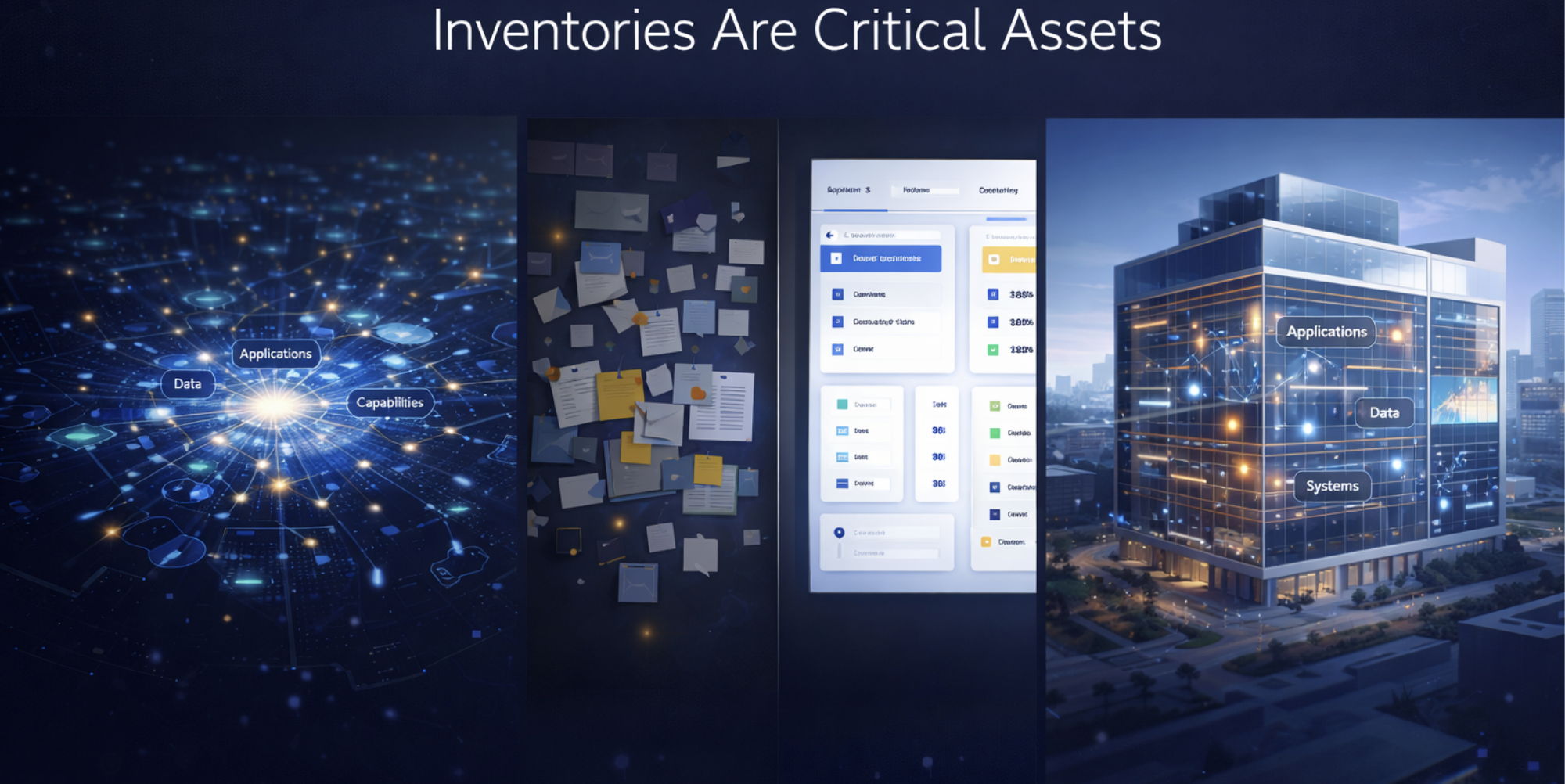
Author: Frank Guerino
The Management Problem Nobody Names
There is a conversation that happens in boardrooms and executive committees with remarkable consistency across industries, geographies, and organizational sizes. A significant decision is on the table — a vendor consolidation, a regulatory response, a merger integration, a technology modernization initiative — and someone asks a question that seems like it should be simple to answer. Which systems are affected? What does this cost us? Who depends on this? What happens if we shut it down? And then the room goes quiet, because nobody knows the answer with confidence.
This is not a failure of intelligence or effort. It is a structural failure — the inevitable consequence of managing a large, complex technology estate without the foundation that makes reliable answers possible. That foundation is an accurate, complete, current, and relationship-rich set of enterprise inventories.
Most organizations have some version of these inventories. They have spreadsheets, configuration management databases, license management tools, contract repositories, and asset registers scattered across IT, finance, procurement, and legal. What they rarely have is a coherent, integrated, continuously maintained Enterprise Model that brings all of those inventory domains together and captures the relationships between them. And it is precisely that integration and those relationships that make the inventories analytically useful rather than just administratively necessary.
This article makes the case for treating enterprise inventories as strategic management assets, catalogues the inventory types that matter most, explains what each one enables, and describes why the relationships between inventories are as important as the inventories themselves. It is written for both executive leaders — who set the organizational priorities that determine whether these inventories are maintained — and the architects and senior IT leaders who design and govern them.
The perspective brought to this article is not theoretical. The author has designed, built, run, and scaled software engineering and architecture organizations at Merrill Lynch and other major enterprises across financial services, life sciences, and other industries. In those roles, the presence or absence of accurate enterprise inventories was not an abstract governance question. It determined the outcome of vendor negotiations involving tens of millions of dollars, defined the speed and reliability of incident response, and either enabled or prevented the kind of strategic decision-making that executive leadership depends on. The examples and principles in this article are drawn directly from that experience.
A Running Example: A Large Diversified Financial Services Organization
To make the concepts in this article concrete, we will reference a single anonymized organization throughout: a large, diversified financial services firm operating across retail banking, commercial lending, wealth management, and insurance lines of business, with a technology estate spanning over 800 applications, thousands of integrations, dozens of major technology vendors, and a technology budget exceeding $1.5 billion annually.
This organization is neither unusual nor extreme. Its characteristics — the scale, the complexity, the organizational fragmentation, the mix of legacy and modern systems, the regulatory exposure — are representative of most large enterprises across financial services, healthcare, life sciences, manufacturing, and government. The inventory challenges it faces, and the value it realizes when it addresses them, are instructive precisely because they are typical.
About the Running Example: This organization is anonymized and represents a composite of real enterprise characteristics. It will be referenced throughout the article to illustrate what each inventory type contains, what management capability it enables, and what the cost of absence looks like in practice.
What We Mean by the Enterprise Model
The term “enterprise inventory” is often understood as a synonym for a spreadsheet or a database table — a list of things the organization owns or manages. That framing undersells the concept significantly, and it is responsible for much of the underinvestment in this area. The more useful and more accurate mental model is the Enterprise Model: an integrated, relationship-rich representation of the organization’s technology landscape and all of the assets that compose it.
Think of the Enterprise Model as a knowledge graph in which every node is an asset — an application, a business capability, an integration, a data entity, a software license, a contract, a hardware component, a vendor, a person, a process — and every edge is a typed, attributed relationship between assets. That application supports this business capability. That integration moves this data entity between those two systems at this frequency using this pattern. That license entitles the organization to deploy this software version on those infrastructure components up to this seat count. That contract governs this vendor relationship and expires on this date under these termination notice requirements. That business process depends on these three applications and produces this data entity that flows downstream to those four consumers.
In this framing, each individual inventory is a domain within the model — a structured collection of nodes of a particular type, with defined attributes and governed relationships to nodes in other domains. None of them is fully useful in isolation. Their value compounds as relationships between domains are established, maintained, and made queryable.
This is the critical distinction between an enterprise that has inventories and one that has an Enterprise Model: the former can tell you what it has; the latter can tell you what anything means in context — what depends on it, what it costs in full, what risk it carries, and what the consequences of any change will be. The first is a record. The second is a management instrument.
Organizations without a maintained Enterprise Model spend their time reacting: scrambling to assemble inventory data in the middle of incidents, regulatory examinations, contract renewals, and board requests — and surrendering leverage at precisely the moments when leverage matters most. Organizations that maintain and model their enterprise do the opposite: they enter every negotiation knowing their own position better than the vendor does, respond to every audit from a position of documented fact, and make every strategic decision from a foundation of current, complete intelligence about the estate they are managing.
Running Example — Enterprise Model: Our financial services organization maintains over thirty distinct inventory domains across its Enterprise Model. The domains most critical to day-to-day management are its Application Inventory (823 applications across seven lines of business), its Integration Inventory (over 4,200 documented integrations), its Software License Inventory (covering more than 180 commercial software products), and its Contract Inventory (over 600 active technology vendor contracts). For years these existed as separate spreadsheets owned by separate teams with no systematic cross-referencing. The consequences — missed renewal windows, compliance exposures, redundant systems, and impact analyses that took weeks — are explored throughout this article.
The Inventory Types That Form the Enterprise Model
A complete Enterprise Model is built from multiple inventory domains, each capturing a distinct category of enterprise asset. The following is a comprehensive catalog of the inventory types that together provide the coverage necessary for effective enterprise management. Each is described with its key attributes, what it enables when properly maintained, and what the absence of it costs. The running example is used to illustrate each type in a realistic context.
1. Application Inventory
The Application Inventory catalogs every software application the organization owns, licenses, or operates — whether commercial off-the-shelf, software-as-a-service, or custom-built. It is the spine of the Enterprise Model: almost every other inventory domain connects to it.
Key attributes per record: application name and description; application type (COTS, SaaS, custom); primary business function and the business capabilities it supports; organizational owner (business and IT); development or vendor responsible; technology stack (languages, frameworks, databases, runtime environments); deployment environment (on-premises, private cloud, public cloud, hybrid); lifecycle status (active, aging, end-of-life, planned for retirement, retired); business criticality rating; data classification of the data it processes; and upstream and downstream integration touchpoints.
What it enables: Application Portfolio Management, business capability gap analysis, cost attribution, decommissioning planning, cloud migration scoping, merger and acquisition due diligence, impact analysis for changes to shared infrastructure, and regulatory data mapping. Without an accurate Application Inventory, all of these activities rely on tribal knowledge and manual investigation.
Running Example — Application Inventory: When the financial services organization initiated a cloud migration program, the project team estimated approximately 400 applications would need to be assessed. After conducting a systematic inventory exercise, they discovered 823 active applications — more than twice the estimated count. The additional applications included departmental tools built by business units, acquired-company systems that had never been formally cataloged, and integration middleware that had been miscategorized as infrastructure. Without this inventory, the migration business case, timeline, and cost estimate would have been built on a significantly incomplete picture.
2. Business Capability Inventory
The Business Capability Inventory catalogs the capabilities the organization needs to perform its business functions — the things the enterprise must be able to do, expressed independently of the specific applications, processes, or people that implement them. Examples in a financial services organization include Customer Onboarding, Credit Risk Assessment, Trade Execution, Regulatory Reporting, Claims Processing, Fraud Detection, and Portfolio Rebalancing.
Key attributes per record: capability name and description; capability level in the hierarchy (Level 1 through Level 3 or deeper, depending on the organization’s capability model); the organizational domain that owns the capability; the applications that currently implement it; the maturity or quality rating of the current implementation; strategic importance; and planned investment direction (invest, maintain, harvest, retire).
What it enables: technology investment prioritization expressed in business terms rather than IT terms; identification of over-invested capabilities (multiple applications doing the same thing), under-invested capabilities (critical business functions supported by fragile or aging technology), and uninvested capabilities (business needs with no current technology support); and business-aligned cost attribution. The capability model also provides the vocabulary for business-IT communication: a capability name means the same thing to a business executive and an enterprise architect.
Running Example — Business Capability Inventory: The organization’s wealth management division had three separate applications performing portfolio performance calculation — one inherited from an acquisition, one built internally in the early 2000s, and one procured two years ago that had not yet been fully rolled out. Without a Business Capability Inventory, this redundancy was invisible across divisional IT boundaries. Once the capability map was built and applications were mapped to it, the redundancy surfaced immediately. Consolidating to a single application eliminated over $2.3 million in annual licensing and support cost.
3. Integration Inventory
The Integration Inventory catalogs every integration that moves data or triggers processes between systems — REST and SOAP APIs, file transfers (SFTP, batch ETL), event streams (Kafka, MQ), database-to-database feeds, real-time message exchanges, and any other mechanism by which one system sends information to or receives information from another. It is the circulatory system of the Enterprise Model.
Key attributes per record: integration name and description; source system and target system (both referencing records in the Application Inventory); integration pattern (synchronous request/response, asynchronous event, scheduled batch, near-real-time stream); technology and protocol; data entities exchanged (referencing records in the Data Inventory); frequency and volume; the business capability and business process supported; criticality; the team responsible for ownership and maintenance; SLA if defined; and current health status.
What it enables: impact analysis (before any system change, identifying all downstream integrations and their targets), dependency mapping for change and release management, incident triage and root cause analysis, integration landscape rationalization, and API governance. An Integration Inventory also reveals integration debt — the accumulation of point-to-point connections, undocumented feeds, and brittle batch processes that represent one of the most significant sources of operational risk in large enterprises.
Running Example — Integration Inventory: When a major trading platform upgrade was proposed, the architecture team estimated five to eight integration touchpoints that would require testing. A systematic inventory review identified 34. Three of those undiscovered integrations fed downstream regulatory reporting systems with mandatory submission deadlines. Discovering them in production after the upgrade, rather than in planning, would have created a material compliance risk. The integration inventory paid for months of maintenance effort in a single avoided incident.
4. Data and Information Inventory
The Data and Information Inventory catalogs the significant data entities the organization creates, manages, and depends on — the nouns of the business: customers, accounts, products, transactions, positions, claims, policies, counterparties, instruments, regulatory submissions, and so on. It is distinct from the Application Inventory (which catalogs systems) and the Integration Inventory (which catalogs flows) — it catalogs the data itself as a first-class managed asset.
Key attributes per record: data entity name and canonical definition; the data domain it belongs to (customer data, financial data, product data, operational data, reference data); the authoritative source system; the downstream systems that consume it; data classification (public, internal, confidential, highly confidential, regulated); applicable regulatory frameworks (GDPR, HIPAA, SOX, CCPA); data owner; data steward; quality standards and known quality issues; and retention and disposal requirements.
What it enables: regulatory data mapping (which personal data does the organization hold, where, and under what legal basis), data lineage analysis, data quality management, master data management strategy, privacy impact assessments, breach response scoping (when a system is compromised, which data entities were potentially exposed), and data-driven cost attribution. In regulated industries, a Data Inventory is increasingly a legal obligation.
Running Example — Data Inventory: When GDPR enforcement began, the organization’s Legal and Compliance team issued a request: identify every system that stores or processes personal data belonging to EU residents. In the absence of a Data Inventory, this required a manual survey of over 800 application owners. The exercise took eleven weeks, involved over 200 people, and produced a result that compliance leadership described as “probably 70% complete.” A maintained Data Inventory would have produced the same answer in hours, with higher confidence. The gap was a $1.4 million remediation cost and a residual compliance exposure that took two additional years to fully close.
5. Software License Inventory
The Software License Inventory catalogs every software license the organization holds — whether for on-premises enterprise software, desktop productivity tools, development platforms, middleware, databases, security tools, or any other licensed software product. It is one of the highest-stakes inventory domains from a financial exposure standpoint.
Key attributes per record: product name and version; vendor; license type (perpetual, subscription, term); license metric (per named user, per concurrent user, per core, per CPU, per server, per device, per instance, by data volume, by transaction volume — metrics vary significantly by vendor and product); entitlement quantity; actual deployment quantity; utilization percentage; annual cost; the contract or purchase order reference; renewal date; and the audit provisions in the governing agreement.
What it enables: license compliance assurance (demonstrating entitlement coverage for every deployed instance), audit defense (responding to vendor audit requests with precision rather than emergency investigation), license optimization (identifying over-licensed products that can be reduced at renewal, and under-licensed products that need immediate remediation), and contract negotiation preparation (knowing actual utilization against entitlement before entering a renewal conversation).
That last point deserves emphasis. In large enterprises, individual software license agreements with major vendors routinely carry contract values of $10 million or more. When an organization enters a renewal negotiation without an accurate, current picture of its own license utilization and deployment, it cedes the most important advantage it has: knowing its own consumption data with the same precision the vendor’s audit team does. A vendor who understands your utilization profile better than you do has already won the negotiation before the first meeting. At Merrill Lynch and other organizations of similar scale, building and maintaining accurate license inventories was not a compliance exercise — it was a prerequisite for negotiating from a position of strength. The difference between walking into a renewal conversation with precise utilization data and walking in without it was routinely measured in millions of dollars.
Running Example — Software License Inventory: A major enterprise software vendor initiated a license audit of the organization. The vendor’s audit team claimed a true-up obligation of $18.7 million based on their deployment scan results. Because the organization’s Software License Inventory was only partially accurate, the initial internal assessment could neither confirm nor dispute the claim with confidence. After a five-month investigation, the actual true-up was negotiated to $4.1 million — but the cost of the investigation, the legal support, and the management distraction was substantial. An accurate inventory would have reduced the entire event to a short conversation.
6. SaaS and Cloud Subscription Inventory
The SaaS and Cloud Subscription Inventory catalogs every cloud-based software subscription and platform service the organization pays for — whether enterprise-wide (Salesforce, Workday, ServiceNow, Microsoft 365) or departmental (marketing automation platforms, analytics tools, developer tools, collaboration services, specialized industry applications). It is distinct from the Software License Inventory in that SaaS subscriptions are typically usage-based, auto-renewing, and frequently acquired outside of central IT procurement.
Key attributes per record: service name and vendor; subscription tier and terms; licensed seats or usage units; actual active utilization; monthly or annual cost; payment method and cost center; renewal date and auto-renewal terms; data handling and residency provisions in the agreement; the business owner; and whether the subscription has been reviewed and approved by IT security.
What it enables: SaaS spend optimization (identifying redundant, underutilized, or unapproved subscriptions), shadow IT visibility (surfacing subscriptions acquired by business units without IT involvement), data residency governance (knowing which business data is stored in which cloud services and under what terms), and renewal management (ensuring that high-value contracts are actively negotiated rather than auto-renewed at potentially unfavorable terms).
Running Example — SaaS Inventory: A SaaS rationalization exercise using expense report analysis and procurement data identified 347 distinct SaaS subscriptions across the organization — compared to the 89 that IT had visibility into through its standard procurement process. Of the 258 subscriptions outside IT visibility, 41 were storing organizational data in cloud services that had not been reviewed for security or compliance. Twelve of those involved customer financial data subject to regulatory data handling requirements. Addressing the exposure required a six-month remediation program. The annual savings from eliminating identified redundancies exceeded $3.8 million.
7. Hardware and Infrastructure Inventory
The Hardware and Infrastructure Inventory catalogs the physical and virtual infrastructure that supports the organization’s technology operations: physical servers, networking equipment (routers, switches, firewalls, load balancers), storage systems (SAN, NAS, object storage), end-user devices (laptops, workstations, mobile devices), and the virtual and cloud infrastructure provisioned to support applications and workloads (virtual machines, containers, cloud compute instances, managed cloud services, IaaS subscriptions).
Key attributes per record: asset type and specification (manufacturer, model, CPU, memory, storage); physical location (data center, floor, rack) or cloud location (provider, region, availability zone); the applications and workloads it supports; owner and responsible team; lifecycle status (active, aging, end-of-support, end-of-life); the maintenance and support contracts that cover it; lease or purchase status; original cost and depreciated value; and for cloud resources, the cost allocation tags and monthly spend.
What it enables: capacity planning, data center consolidation analysis, hardware refresh planning and budgeting, cloud cost management (identifying idle or underutilized cloud resources), end-of-support risk management (identifying infrastructure components that will no longer receive security patches), asset depreciation tracking for finance, and the infrastructure dependency layer of impact analysis.
Running Example — Infrastructure Inventory: During a data center consolidation program, the organization conducted a physical audit of its primary data center and discovered 340 servers that were not in any inventory system. Of those, 127 were actively serving applications that were unknown to the Architecture team. Seventeen were running at end-of-support OS versions that had not received security patches in over three years. The discovery added fourteen weeks to the consolidation program and required an emergency security remediation effort for the unpatched systems. A current infrastructure inventory would have made these systems visible years earlier.
8. Contract Inventory
The Contract Inventory catalogs every material contract the organization holds with technology vendors and service providers: software license agreements, SaaS subscription agreements, hardware purchase and lease agreements, maintenance and support contracts, professional services agreements, outsourcing and managed service agreements, cloud provider agreements, and data processing agreements. It is the legal and financial backbone of the technology estate.
Key attributes per record: contract identifier and title; counterparty (vendor or service provider); contract type; covered products, services, or assets; total contract value and payment schedule; effective date; initial term end date; renewal options and auto-renewal terms; termination notice requirements and deadlines; key performance obligations and SLAs; penalty and remedy provisions; data handling, security, and breach notification obligations; audit rights; governing law and dispute resolution terms; and the business and legal owner of the contract.
What it enables: proactive renewal management (engaging vendors in renegotiation well before auto-renewal deadlines), termination planning (identifying contracts that can be exited when the business case no longer exists), compliance assurance (ensuring that vendor contractual obligations around data handling and security are consistent with the organization’s regulatory requirements), SLA monitoring, and comprehensive vendor risk assessment. The Contract Inventory is also the only reliable basis for the organization’s technology-related financial obligations disclosure to auditors and regulators.
The negotiation leverage point applies as much to contracts as to licenses. At Merrill Lynch, managing a technology organization at scale meant routinely negotiating enterprise agreements for software licenses, hardware leases, and service subscriptions where individual contracts exceeded $10 million. In those negotiations, the fundamental dynamic was straightforward: the vendor’s account team had a precise picture of what the organization was consuming, what it was paying, and when its contractual options expired. If the organization’s own Contract and License Inventories were accurate and current, it could enter the conversation as an equal. If they were not, the vendor had more actionable information about the organization’s position than the organization’s own team did. That asymmetry is not abstract — it determines concretely whether a renewal results in improved terms, flat terms, or deteriorating terms. The organizations that negotiate best are invariably the ones that know their own data.
Running Example — Contract Inventory: A review of the organization’s enterprise software contracts identified eleven agreements with auto-renewal clauses and termination notice windows of 90 to 180 days that had passed unnoticed in the preceding two years. In three cases, the organization had been actively evaluating replacement products at the time the notice window closed, but the renewal was processed automatically because nobody was tracking the deadline. The unintended contract commitments totaled approximately $7.2 million. All eleven would have been manageable with a maintained Contract Inventory and a renewal calendar integrated with it.
9. Lease Inventory
The Lease Inventory catalogs every asset the organization leases rather than owns outright, with specific focus on technology-related assets: hardware under financial or operating leases, data center and co-location facility leases, wide area network circuits and connectivity leases, and any other technology-related assets subject to lease agreements. It is distinct from the Hardware Inventory (which catalogs what the assets are and where they are) in that it captures the legal and financial terms of the lease relationship.
Key attributes per record: leased asset or facility description; lessor; lease type (operating or finance under ASC 842 / IFRS 16); commencement date; lease term end date; payment amount and schedule; buyout option terms; renewal option terms; return conditions; early termination provisions; the accounting classification and right-of-use asset value; and any maintenance, insurance, or other obligations carried by the lessee.
What it enables: lease accounting compliance (ASC 842 and IFRS 16 require organizations to recognize most leases on the balance sheet, which requires a complete and accurate lease inventory), renewal and return planning, financial obligation forecasting, and identification of leases on assets that are no longer needed but are generating ongoing cost that could be terminated or restructured.
Running Example — Lease Inventory: During preparation for an ASC 842 adoption, the finance team requested a complete inventory of all technology-related operating leases from IT. The exercise identified 94 active hardware leases across 23 lessors — a number that surprised both Finance and IT leadership, as neither had previously had a consolidated view. Eleven leases were on hardware that had been replaced and was no longer in use, representing $840,000 in annual payments for assets providing no value. The leases remained because no systematic process existed to connect hardware disposal decisions to lease management.
10. Vendor and Third-Party Inventory
The Vendor and Third-Party Inventory catalogs the external organizations the enterprise depends on for technology products and services: software vendors, hardware manufacturers, cloud providers, managed service providers, system integrators, outsourcing partners, data providers, and any other third party with access to organizational systems, data, or infrastructure. Third-party risk management has become a board-level concern in most industries, and this inventory is its foundation.
Key attributes per record: vendor name and legal entity; relationship type and category; the specific products or services provided; the systems and data they have access to (referencing Application, Infrastructure, and Data Inventory records); the contracts governing the relationship (referencing Contract Inventory records); the security and compliance certifications held (SOC 2, ISO 27001, PCI-DSS, etc.); the risk classification (critical, high, medium, low); the result of the most recent third-party risk assessment; subcontractor and fourth-party dependencies; and the internal business owner of the relationship.
What it enables: third-party risk management and continuous monitoring, supply chain attack surface assessment, vendor concentration risk analysis (identifying business processes that depend on a single vendor with no viable alternative), regulatory compliance demonstration (many frameworks require documented third-party risk programs), vendor rationalization, and informed response to vendor security incidents or financial distress events.
Running Example — Vendor Inventory: When a major cloud infrastructure provider experienced a regional outage, the organization’s incident response team needed to rapidly assess which business processes and applications were affected. Without a connected Vendor-to-Application mapping, this required phone calls and emails to over 40 application owners over a four-hour period while executives were demanding answers. A connected Vendor Inventory would have produced the complete affected-application list in minutes. The same gap was identified during a tabletop exercise simulating a breach at a major SaaS vendor: the team could not determine in real time which customer data that vendor had access to.
11. Personnel and Skills Inventory
The Personnel and Skills Inventory catalogs the human capabilities the organization has available for technology work: the roles, competencies, certifications, and system ownership of IT staff and key technology practitioners. It is the most frequently overlooked of the core inventory domains, and often the most consequential when it is absent.
Key attributes per record: individual or role; technology domains and platforms with proficiency level; specific systems owned, maintained, or deeply familiar with (referencing Application and Infrastructure Inventory records); certifications held; years of experience in relevant areas; knowledge dependencies (systems or processes whose continued operation depends on this individual’s institutional knowledge); succession or backup coverage; and current organizational assignment.
What it enables: identification of knowledge concentration risks (single points of failure where one person’s departure would leave a critical system or process without a qualified steward), skills gap analysis for new technology adoption, staffing and succession planning, vendor and contractor dependency assessment, and organizational impact analysis for restructuring or workforce reduction decisions.
Running Example — Personnel Inventory: When a senior integration architect with 22 years of tenure retired, his team discovered that he was the sole person with working knowledge of the configuration and undocumented business rules embedded in seven critical batch integration processes connecting the core banking system to downstream reporting and regulatory systems. The processes continued to run, but nobody understood them well enough to modify them safely or to diagnose issues when they failed. A six-month knowledge capture and remediation effort was required. A Personnel Inventory with knowledge dependency mapping would have surfaced this risk years earlier and prompted a planned knowledge transfer.
12. Process and Workflow Inventory
The Process and Workflow Inventory catalogs the significant business and operational processes the organization depends on — particularly those that are automated, partially automated, or system-dependent. It captures not just that a process exists but how it operates: which systems it spans, which data it consumes and produces, which roles execute it, what its triggers and outcomes are, and where it is documented.
Key attributes per record: process name and description; the business capability it implements; the applications that support it (referencing the Application Inventory); the data entities it consumes and produces; the people or roles involved; whether the process is manual, partially automated, or fully automated; the automation technology used (RPA, workflow engine, orchestration platform, scripted); process owner; regulatory obligations the process fulfills; and known quality or reliability issues.
What it enables: process automation opportunity identification, operational risk assessment (identifying processes that are manual, poorly documented, or dependent on a single system or person), regulatory traceability (demonstrating that required processes are implemented and controlled), business continuity planning, and change impact analysis for process-dependent applications. The Process Inventory is the operational layer between the Business Capability Inventory (what the organization must be able to do) and the Application Inventory (what systems implement it).
Running Example — Process Inventory: A regulatory examination required the organization to demonstrate that its anti-money-laundering transaction monitoring process was implemented with appropriate controls across all business lines. The compliance team discovered that the process was implemented differently in four separate business units, with different systems, different thresholds, different escalation paths, and different documentation standards. None of the four implementations was captured in any inventory. Documenting and harmonizing them required eight months of work. A Process Inventory would have surfaced the fragmentation years before the examination.
13. API and Service Inventory
The API and Service Inventory catalogs every programmatic interface the organization exposes or consumes — internal APIs used for system-to-system communication, externally published APIs consumed by partners or customers, and third-party APIs the organization depends on. As organizations adopt microservices architectures, API management platforms, and event-driven designs, the API inventory becomes a critical governance artifact in its own right, distinct from but complementary to the Integration Inventory.
Key attributes per record: API or service name and description; the system that exposes it (referencing the Application Inventory); the API specification version and format (OpenAPI, WSDL, AsyncAPI, GraphQL schema); authentication and authorization model; the consuming systems or external parties; rate limits and usage quotas; SLA and availability commitments; deprecation status and planned sunset; data classification of payloads; and the team responsible for ownership and versioning.
What it enables: API governance (enforcing standards for authentication, versioning, documentation, and lifecycle management), change management (identifying all consumers of an API before deprecating or modifying it), security assessment (ensuring APIs are consistently authenticated and that sensitive data is not exposed through public endpoints), partner and customer dependency management, and API monetization tracking for organizations that generate revenue from published APIs.
Running Example — API Inventory: The organization’s payments platform team decided to deprecate a version 1 payment initiation API that had been superseded by a version 3 release eighteen months earlier. After announcing the deprecation, they received notifications from eleven internal teams and two external fintech partners that they were still consuming v1 and had not been informed of the v3 availability. Three of the internal consumers had been scheduled for decommissioning but were still actively running. Without an API Inventory tracking active consumers, the deprecation would have produced production outages across thirteen parties. The migration required four additional months.
14. Cloud Resource Inventory
The Cloud Resource Inventory catalogs every resource provisioned in cloud environments — whether infrastructure as a service (virtual machines, storage, networking), platform as a service (managed databases, container orchestration, serverless functions), or cloud-native services (object storage, message queues, CDN, DNS, identity services). As cloud environments grow, resource sprawl — provisioned resources that are idle, oversized, or orphaned from the workloads they were created to support — becomes a significant source of unmanaged cost and security exposure.
Key attributes per record: resource type and specification; cloud provider and account; region and availability zone; the workload or application it supports (referencing the Application Inventory); provisioning date; last active use date; cost (hourly, monthly, or annual); the team or cost center responsible; cost allocation tags; security group and network access configuration; and whether the resource has been reviewed as part of a periodic cloud cost optimization exercise.
What it enables: cloud cost management and FinOps (identifying idle, oversized, or redundant cloud resources), cloud security posture management (identifying misconfigured resources with overly permissive access), cloud governance (enforcing tagging standards, account structures, and approved resource types), and accurate cloud spend attribution to business units and applications.
Running Example — Cloud Resource Inventory: A cloud cost optimization initiative using automated scanning tools identified over $4.2 million in annual cloud spend attributable to resources that were either idle, severely oversized for their actual workload, or had been orphaned when the applications they supported were decommissioned. Many of these resources had been provisioned years earlier and had never been reviewed. Forty-three of the orphaned resources retained network access configurations that allowed them to communicate with production systems — a security exposure that had existed undetected for an average of 26 months.
15. Configuration and Change Inventory
The Configuration and Change Inventory — often implemented as a Configuration Management Database (CMDB) in IT service management frameworks — catalogs the specific configuration states of managed technology assets: the installed software versions, applied patches, configuration parameters, and known-good states that define how each system component is expected to behave. It is the operational layer of the hardware and application inventories, capturing not just that an asset exists but exactly how it is configured.
Key attributes per record: configuration item (CI) identifier; the asset it describes (referencing Application, Infrastructure, or Network Inventory records); the specific attributes being tracked (OS version, patch level, application version, configuration parameter values); the date of last verified configuration; the change history for this configuration item; the baseline configuration this state is being compared against; and the change records associated with any deviations from baseline.
What it enables: change management governance (ensuring that configuration changes are tracked and authorized), incident root cause analysis (comparing current configuration against known-good baseline to identify unauthorized or unexpected changes), security vulnerability management (identifying which systems are running unpatched software versions), compliance evidence (demonstrating that systems are configured to required security standards), and drift detection (alerting when configurations deviate from approved baselines without an associated authorized change record).
16. Technical Debt Inventory
The Technical Debt Inventory catalogs the known architectural, design, and implementation deficiencies in the technology estate — the decisions made under time pressure, the deferred upgrades, the workarounds that became permanent, the integrations built without proper design, and the systems that have outlived the architectural patterns they were built on. Technical debt is a liability, and like financial debt, it carries interest: the longer it is left unaddressed, the more expensive it becomes to service.
Key attributes per record: debt item description and category (architectural, design, implementation, dependency, operational); the system or component affected (referencing the Application or Infrastructure Inventory); the root cause and circumstances that created the debt; the estimated remediation effort; the risk associated with leaving it unaddressed; the business impact of the debt (performance, reliability, maintainability, security); the owner responsible for remediation; and the priority and planned resolution timeline.
What it enables: technical debt prioritization and roadmap planning, risk-adjusted investment decision making (understanding the true cost of continuing to operate on aging or deficient foundations), engineering productivity measurement (teams working in high-debt environments are slower and produce less reliable output), and budget justification for modernization investments (technical debt that is quantified and connected to business risk is far more persuasive to finance leadership than technical debt described in abstract terms).
Running Example — Technical Debt Inventory: When the organization sought board approval for a $180 million core banking modernization program, the CFO asked for a quantified assessment of the cost of not proceeding. The Architecture team had a general sense of the technical debt in the current platform but had never formally inventoried or quantified it. Constructing that case from scratch took six weeks. An existing Technical Debt Inventory, continuously maintained, would have made the investment case immediately available and would have demonstrated to the board that the architecture organization had been actively tracking and managing the risk rather than discovering it in preparation for a funding request.
17. Compliance and Regulatory Obligation Inventory
The Compliance and Regulatory Obligation Inventory catalogs the regulatory frameworks, legal obligations, and compliance requirements that apply to the organization’s technology operations — and maps each obligation to the systems, processes, data, and controls that implement it. This inventory transforms compliance from an audit exercise into an operational capability.
Key attributes per record: regulatory framework or legal obligation (e.g., SOX Section 404, HIPAA Security Rule, GDPR Article 32, PCI-DSS Requirement 6, NYDFS Part 500); specific requirement or control; the systems that are in scope for this requirement (referencing Application and Infrastructure Inventory records); the data entities subject to this requirement (referencing the Data Inventory); the processes that implement or evidence compliance; the control owner; the last assessment date and result; and any open findings or remediation items.
What it enables: continuous compliance monitoring (rather than point-in-time audit preparation), rapid regulatory inquiry response, change impact assessment for regulatory scope (when a system change is proposed, identifying which regulatory obligations apply to the affected systems), new regulation scoping (when a new regulatory requirement is introduced, identifying which systems, processes, and data are in scope), and board-level compliance posture reporting.
18. Project and Initiative Inventory
The Project and Initiative Inventory catalogs the active and planned technology projects and transformation initiatives — including their scope, objectives, dependencies on existing systems, planned changes to the technology landscape, resource commitments, and status. It is the dynamic layer of the Enterprise Model: it captures not just what the estate is today but what it is actively becoming.
Key attributes per record: project name and description; strategic objective or business problem being addressed; the applications, infrastructure, and integrations being created, modified, or retired (referencing those inventory records); start and planned end date; budget and resource allocation; dependencies on other projects or milestones; current status and health (on track, at risk, delayed); the executive sponsor and project owner; and the target state architecture the project is working toward.
What it enables: portfolio-level dependency management (identifying projects that share dependencies or whose sequencing matters), resource conflict identification (detecting when competing projects are drawing on the same teams or systems simultaneously), roadmap visualization (showing how the technology landscape will evolve over the planning horizon), and investment performance tracking (connecting project spend to the changes actually delivered in the Enterprise Model).
A Roadmap Reference: Enterprise Inventory Types and Their Value
The table below is intended as a practical starting point for IT leaders and enterprise architects. No organization needs all of these inventories on day one, and few organizations maintain all of them well even at maturity. The value of this reference is in making the landscape visible: which inventories your organization currently maintains, which are missing or incomplete, and in what sequence to prioritize building them out based on the risk and value they carry.
Every inventory type comes with its own set of key traits — attributes that must be maintained alongside the basic record to make the inventory analytically useful. It is the traits, not just the existence of the inventory, that determine whether leadership can answer the questions that matter most. For example, knowing that an application exists tells you little. Knowing that it is classified as business-critical, processes regulated personal data, and has fourteen downstream integration dependencies tells you everything you need to prioritize it correctly in an incident, a regulatory examination, or a migration program. Where traits are particularly consequential for executive decision-making, the table calls them out explicitly.
For Licenses, Leases, and Subscriptions in particular, tracking allocation by business unit and actual consumption rate against entitlement is not optional — it is the specific data that determines whether the organization enters a vendor negotiation with leverage or without it. The organization that knows its own consumption data with precision can challenge vendor claims, right-size entitlements, and negotiate from fact. The one that does not cedes that advantage entirely.
The Roadmap Priority column uses three recommended designations: Foundational (build these first — other inventories depend on them or are significantly less useful without them), High (critical for near-term risk management, cost control, or operational reliability), and Medium (important and valuable, but can follow once the foundational and high-priority inventories are established).
| Inventory Type | What It Captures | Why It Matters to Leadership | Priority |
|---|---|---|---|
| APIs and Integrations | Every programmatic interface and integration the organization exposes or consumes — REST and SOAP APIs, event streams, batch feeds, message queues — including source system, target system, data exchanged, consumers, SLA, lifecycle status, and ownership. | Makes impact analysis reliable: before any system change, reveals every downstream consumer affected. Enables API governance, security posture assessment, and dependency mapping for change and release management. | High |
| Applications | Every software application the organization owns, licenses, or operates — COTS, SaaS, or custom-built — including owner, technology stack, deployment environment, lifecycle status, and the business capabilities it supports. Key traits: business criticality rating and data classification of the data each application processes are the two attributes that unlock impact analysis prioritization and regulatory scoping across the entire portfolio. | The spine of the Enterprise Model — almost every other inventory connects to it. Enables Application Portfolio Management, cloud migration planning, cost attribution, merger due diligence, and regulatory data mapping. | Foundational |
| Best Practices | Approved methods, techniques, and standards of practice across technology and business domains, including applicability, adoption status, and organizational owner. | Accelerates onboarding, improves delivery quality, and provides the baseline against which architecture and engineering decisions are evaluated. Reduces repeated discovery of solutions to known problems. | Medium |
| Capabilities & Functions | The capabilities the organization must perform to conduct its business, organized hierarchically and mapped to the applications and processes that implement them, with maturity ratings and investment direction. | Enables investment prioritization in business terms: identifies over-invested capabilities (redundant systems), under-invested capabilities (critical functions on fragile technology), and uninvested capabilities (business needs with no technology support). | Foundational |
| Cloud Accounts (and their virtual assets) | Every cloud provider account and the virtual resources provisioned within them — compute, storage, networking, managed services — including account hierarchy, cost allocation tags, resource owner, security posture, and monthly spend. | Controls cloud sprawl, enables FinOps discipline, surfaces idle and orphaned resources, and provides the visibility required for cloud security governance and accurate cost attribution to business units. | High |
| Computing Devices (Servers, Desktops, Laptops, Mobile Devices, Mainframes, etc.) | Every physical computing asset the organization owns or manages, including specification, location, assigned user or team, lifecycle status, support contract coverage, and the applications or workloads it supports. | Enables asset lifecycle management, hardware refresh planning, end-of-support risk identification, security patch coverage, and the infrastructure dependency layer of impact analysis. | High |
| Contracts | Every material technology vendor contract — software licenses, SaaS agreements, hardware leases, managed services, outsourcing, and data processing agreements — including financial terms, key dates, renewal and termination provisions, obligations, and business owner. | Prevents unintentional auto-renewals, enables proactive renegotiation from an informed position, surfaces contractual obligations that may conflict with regulatory requirements, and provides the financial obligations baseline for audit and board reporting. | High |
| Customers | Customer relationships, accounts, entitlements, regulatory classifications, and the systems and data that serve them. | Enables customer impact analysis for system changes, supports regulatory scoping (which customers are subject to which regulatory frameworks), and informs service prioritization and continuity planning. | High |
| Data & Information Inventories | The specific types of data and information that exist within and move between enterprise assets — customer records, financial transactions, clinical data, product data, regulatory submissions, reference data — including business definitions, data ownership, and regulatory framework applicability. Key traits: data classification (public, internal, confidential, regulated) and applicable regulatory frameworks are the two attributes that answer the sensitive data questions regulators, security teams, and privacy officers ask most frequently. | Required for regulatory compliance (GDPR, HIPAA, PCI-DSS), breach response scoping, data governance, AI governance, and any cross-domain query that asks which systems handle sensitive or regulated data. | Foundational |
| Data Integrations | Every pipeline, ETL process, event stream, and data feed that moves data between systems — including source, target, data entities carried, frequency, volume, transformation logic, and ownership. | Enables data lineage analysis, regulatory reporting traceability, data quality management, and impact analysis for changes to systems that produce or consume shared data. | High |
| Data Stores (Databases, Object Stores, File Systems, etc.) | Every data storage system the organization operates — relational databases, NoSQL stores, object stores, file systems, data lakes, data warehouses — including type, location, owner, the applications it serves, and the data classification of its contents. | Supports data governance, security posture assessment, migration planning, compliance scoping, and the infrastructure layer of data lineage analysis. | High |
| Enterprise Risks | Known risks facing the organization across strategic, operational, financial, compliance, and technology domains — expressed in business terms — including severity, likelihood, owner, mitigation status, and the assets or processes at risk. | Feeds the enterprise risk register, board and audit committee reporting, risk-adjusted investment decision making, and regulatory examination responses. Connects technical exposures to business consequences. | High |
| External Offerings (Products & Services) | The products and services the organization offers to external customers and partners, including their technology dependencies, supporting systems, and the business capabilities that deliver them. | Enables product impact analysis, customer commitment management, and the connection between technology investment and revenue-generating offerings. Critical for organizations where IT directly supports customer-facing products. | Medium |
| Facilities (Offices, Data Centers, Warehouses, etc.) | Physical locations the organization occupies or operates, including lease or ownership status, capacity, the technology assets housed within them, environmental and power specifications, and operational status. | Supports real estate rationalization, data center consolidation, business continuity planning, and the physical location layer of infrastructure impact analysis. | Medium |
| Intellectual Property (IP) | Patents, trademarks, proprietary algorithms, trade secrets, and licensed-in IP — including ownership, registration status, jurisdiction, expiration dates, and the products or systems that depend on or embody the IP. | Increasingly critical as AI-generated artifacts raise ownership questions. Supports IP protection, licensing revenue management, M&A valuation, and identification of IP that may be inadvertently exposed through vendor or cloud relationships. | Medium |
| Internal Services | Technology and business services the organization provides internally — shared platforms, middleware, common data services, enterprise integration hubs — including the teams that provide them, consuming teams, SLAs, and cost recovery model. | Enables internal service governance, chargeback accuracy, SLA management, and rationalization of shared services that may be duplicated across organizational units. | Medium |
| Leases | Assets the organization leases rather than owns — hardware, facilities, network circuits — including lessor, lease type (operating or finance), term, payment schedule, renewal and buyout options, and return conditions. Key traits: allocation to business unit and actual utilization rate are the attributes that determine whether a lease renewal is justified, can be reduced in scope, or should be exited. | Required for lease accounting compliance (ASC 842, IFRS 16), renewal and return planning, identification of leases on underutilized or retired assets, and the financial obligation baseline for audit. | High |
| Licenses | Every software license the organization holds — including product, vendor, license metric, entitlement quantity, actual deployment quantity, and the contract reference. Key traits: allocation by business unit and actual consumption rate are the two attributes that determine whether the organization enters a renewal negotiation with leverage or without it. A vendor who knows your utilization better than you do has already determined the outcome. | Enables license compliance assurance, audit defense, optimization (right-sizing entitlements at renewal), and the negotiating foundation for major vendor contracts — individually often exceeding $10 million. | High |
| Network and Connectivity Assets | WAN circuits, VPN tunnels, peering agreements, CDN configurations, DNS infrastructure, and other connectivity assets — including provider, bandwidth, SLA, cost, and the systems and locations they connect. | Supports network capacity planning, provider rationalization, business continuity planning, and the connectivity layer of infrastructure impact analysis. Increasingly material as hybrid and multi-cloud architectures create complex network dependency chains. | Medium |
| Organizations | The organizational units of the enterprise — business divisions, IT teams, shared service groups — including their structure, leadership, technology responsibilities, and the assets and capabilities they own. | Provides the organizational context for every other inventory: who owns which assets, who is accountable for which capabilities, and which organizational units are affected by any given change or incident. | Foundational |
| Partners | External organizations with which the enterprise has strategic or operational partnerships — joint ventures, channel partners, technology alliances — including the nature of the relationship, shared systems, data exchanges, and governing agreements. | Supports partner impact analysis, shared system governance, data sharing compliance, and the assessment of dependencies that carry both operational and reputational risk. | Medium |
| Personnel and Skills | The technology roles, competencies, certifications, and system ownership of IT staff and key practitioners. Key traits: systems owned and knowledge dependencies — which systems or processes depend on this individual's institutional knowledge — are the two attributes that surface concentration risks before they become incidents. | Identifies single points of failure where one person's departure would leave a critical system without a qualified steward. Enables skills gap analysis, succession planning, and organizational impact assessment for restructuring decisions. | High |
| Policies | Organizational policies governing technology use, data handling, security, compliance, and operations — including scope, owner, effective date, and the systems or processes subject to each policy. | Provides the governance framework against which technology decisions and configurations are assessed. Enables policy gap analysis, compliance traceability, and the connection between regulatory obligations and organizational rules. | High |
| Procedures | Documented step-by-step instructions for performing specific technology tasks — operational runbooks, deployment procedures, incident response playbooks — including the systems involved, roles responsible, and last-verified date. | Reduces operational risk from staff turnover, supports consistent execution of critical processes, and provides the evidence base for audit and regulatory examination of operational controls. | Medium |
| Processes | Significant business and operational processes the organization depends on — particularly those that are automated, partially automated, or system-dependent — including the applications that support them, data consumed and produced, and regulatory obligations fulfilled. | Provides the operational layer between business capabilities (what the organization must do) and applications (what systems implement it). Enables process automation opportunity identification, operational risk assessment, and business continuity planning. | High |
| Projects and Initiatives | Active and planned technology projects and transformation programs — including scope, objectives, affected systems, dependencies, budget, status, and the target state architecture each project is working toward. | Enables cross-project dependency management, resource conflict identification, roadmap visualization, and investment performance tracking. The dynamic layer of the Enterprise Model — what the estate is actively becoming. | High |
| Regulations | The regulatory frameworks and laws that apply to the organization's technology operations and data handling — GDPR, HIPAA, SOX, PCI-DSS, NYDFS, and their sector-specific equivalents — including jurisdiction, effective date, and responsible compliance function. | Provides the regulatory baseline against which the Regulatory Obligations inventory is built. Enables rapid scoping of new regulatory requirements and the organizational context for compliance investment decisions. | High |
| Regulatory Obligations | Specific requirements and controls derived from applicable regulations — mapped to the systems, processes, data, and organizational units subject to each obligation — including control owner, last assessment date, and open findings. | Transforms compliance from audit preparation into continuous monitoring. Enables change impact assessment for regulatory scope, rapid response to regulatory inquiries, and board-level compliance posture reporting. | High |
| Security Vulnerabilities and Risks | Identified technical exposures at the system and component level — open CVEs, penetration test findings, misconfigured resources, unpatched endpoints, open audit findings — mapped to the affected assets and business processes. | Enables vulnerability prioritization by business criticality and blast radius, attack surface management, and the technical evidence base for the Enterprise Risks inventory. Feeds remediation planning and security investment prioritization. | High |
| Software | Every software product installed or deployed in the enterprise — operating systems, middleware, development tools, utilities, firmware — including version, vendor, deployment locations, and support status. | Supports patch management, end-of-support risk identification, software asset management, and the full software bill of materials required for supply chain security and regulatory compliance. | High |
| Standards | Approved technology standards the organization has adopted — architecture standards, integration standards, coding standards, security standards, data standards — including applicability domain, adoption status, and governing body. | Provides the technical baseline for architecture governance, vendor selection, and build-vs-buy decisions. Enables consistency across teams and the traceability required to demonstrate standards compliance to auditors. | Medium |
| Subscriptions | Every recurring subscription the organization pays for — SaaS platforms, cloud services, data feeds, developer tools, industry content services — including tier, licensed seats or usage units, actual utilization, renewal date, and auto-renewal terms. Key traits: allocation by business unit and consumption rate are the attributes that identify redundant, underutilized, or unapproved subscriptions before they auto-renew. | Controls subscription sprawl, surfaces shadow IT, enables spend rationalization, and ensures that organizational data is not persisting in unsanctioned cloud services outside IT governance. | High |
| Technical Debt | Known architectural, design, and implementation deficiencies in the technology estate — deferred upgrades, legacy dependencies, architectural anti-patterns, undocumented workarounds — including estimated remediation effort, business impact, and risk of leaving unaddressed. | Makes technical debt visible, quantifiable, and risk-rated so that modernization investment can be justified in business terms. Debt that is inventoried and connected to business risk is far more persuasive to finance leadership than debt described abstractly. | High |
| Vendors | External organizations that supply technology products and services — software vendors, hardware manufacturers, cloud providers, managed service providers, system integrators — including the products and services they provide, systems and data they access, contracts governing the relationship, security certifications, and risk classification. | Foundations of third-party risk management, supply chain security, vendor concentration analysis, and regulatory compliance programs that require documented vendor risk programs. Connects to Contract and Application inventories for full dependency traversal. | High |
| Operational Inventories — The Dynamic, Time-Series Layer of the Enterprise Model | |||
| Changes | Every planned modification to the technology estate — including change type, affected systems, risk assessment, approval status, implementation outcome, and post-implementation review. | Makes the Configuration Inventory trustworthy by explaining deviations from baseline. Enables change governance, post-incident root cause analysis, and the audit trail required by regulatory change management controls. | High |
| Incidents | Unplanned interruptions or degradations to services — including severity, affected systems, business impact, duration, resolution, and the personnel involved in response. | Feeds root cause analysis, pattern recognition, and SLA reporting. Connected to the Application and Integration Inventories, reveals which parts of the technology estate are most operationally fragile. | High |
| Known Errors | Documented defects for which a root cause is known but a permanent fix has not yet been implemented — including the affected systems, the interim workaround, and the planned resolution timeline. | The bridge between Problem Management and Technical Debt. Ensures that known issues are tracked, visible to operations staff, and factored into risk and capacity planning rather than rediscovered repeatedly. | Medium |
| Problems | The underlying root causes of one or more incidents — tracked through investigation, root cause identification, and permanent resolution — including the affected systems and the incidents they generated. | Separates reactive from proactive operations. A maintained Problem inventory reveals systemic weaknesses in the technology estate before they generate the next wave of incidents. | High |
| Service Requests and Responses | Requests for routine, pre-approved services — access provisioning, equipment requests, software installations — paired with the responses delivered: fulfillment time, quality, cost, and outcome. | Together, Requests and Responses reveal whether the organization is meeting its service commitments. The gap between what was requested and what was delivered is one of the most direct measures of IT service effectiveness available to leadership. | Medium |
Why the Relationships Between Inventories Matter As Much As the Inventories Themselves
Each inventory domain described above has standalone value. But the most significant management capabilities emerge not from any individual inventory but from the typed, attributed relationships between inventory domains — the connections that allow an organization to traverse the Enterprise Model from any starting point and answer questions that no single inventory could answer alone.
In graph terms: the nodes are the inventory records. The edges are the relationships. And the most valuable queries are those that traverse multiple hops across the graph — starting from one asset type, following relationships through intermediate types, and arriving at an answer that spans the full breadth of the model.
Consider a few examples of multi-hop traversal that become possible only when inventories are connected:
-
Application → Capability → Process: Which business processes would be interrupted if this application were unavailable for 48 hours? This traversal identifies not just that a capability is affected but which operational processes, and therefore which business transactions and regulatory obligations, would be disrupted.
-
License → Application → Infrastructure: What is the fully loaded cost of this application — combining license fees, infrastructure costs, and support contracts? This traversal enables true TCO analysis that no single inventory can provide.
-
Contract → Vendor → Application → Data: If this vendor were acquired by a competitor, which of our applications depend on them, and which categories of customer or regulated data do those applications process? This traversal enables both competitive risk assessment and regulatory notification scoping.
-
Integration → Application → Compliance Obligation: If we upgrade this application, which integrations will be affected, and which of those integrations carry data that is in scope for PCI-DSS? This traversal ensures that change management includes the appropriate compliance review.
-
API → Application → Vendor → Contract: Which of the external APIs we depend on are provided by vendors whose contracts expire within six months, and what are the termination notice requirements? This traversal surfaces renewal and continuity risks in advance.
These are not analytical exercises performed once a year. They are questions that arise continuously in the course of managing a large technology estate — during incident response, change planning, contract review, regulatory examination, budget preparation, and strategic planning. An organization with a connected Enterprise Model answers them in real time. One without it answers them in weeks, if at all.
Running Example — Relationship Value: The organization’s risk management team conducted a vendor concentration analysis using the connected Enterprise Model. The query: which single vendor, if it experienced a catastrophic service disruption, would affect the largest number of revenue-generating business processes? The answer identified a mid-tier infrastructure monitoring vendor that, through a chain of Application and Integration relationships, was connected to monitoring coverage for 34% of the organization’s revenue-generating applications. The vendor had a single-region deployment model with no redundancy commitment in its SLA. This concentration risk had been invisible until the connected inventory made the traversal possible. A vendor diversification program was initiated before an incident forced the issue.
Who Is Accountable: A Federated Model with Central Ownership
Enterprise inventories do not maintain themselves, and no single team can maintain all of them well. The organizations that succeed with this discipline consistently operate on the same governance model: federated creation and maintenance, with centralized accountability and integration.
The principle behind federated maintenance is straightforward. The teams closest to a given asset category are best positioned to create and keep current the inventories for that category. The team responsible for provisioning employees with computing devices — laptops, desktops, mobile phones — has direct operational knowledge of the device fleet, the procurement relationships, the refresh cycles, and the deployment state. They will produce a more accurate and more current Hardware Inventory for that domain than any central team could. The same logic applies across the board: the cloud infrastructure team knows the Cloud Resource Inventory, the procurement team knows the Contract and License Inventories, the security team knows the vulnerability data, the application development teams know the API and Integration Inventories for their systems. Requiring a central organization to maintain all of these directly would be both impractical and inferior in quality.
The risk of pure federation, however, is fragmentation: each team optimizes its inventory for its own operational needs, applies its own naming conventions, uses its own schema, and has no incentive to ensure its data is joinable with anyone else’s. The Application Inventory maintained by the infrastructure team may not use the same application identifiers as the License Inventory maintained by procurement. The Integration Inventory maintained by the middleware team may not reference the same system names as the Application Inventory maintained by the portfolio team. Federated inventories without a unifying model are not an Enterprise Model — they are a collection of silos with different keys.
This is where centralized accountability becomes essential. The Architecture and Engineering organization — typically reporting to the CIO or CTO — is the natural home for that accountability. Its role in the federated model is not to maintain every inventory directly but to perform several functions that no federated team can perform for itself:
-
Define and govern the schemas, taxonomies, naming conventions, and relationship models that make federated inventories joinable across domains
-
Establish the contribution standards by which federated teams share their inventory data with the Enterprise Model — including the format, frequency, and quality thresholds expected
-
Own the Enterprise Model itself — the integrated, relationship-rich whole that is analytically more powerful than the sum of its federated parts
-
Apply the Enterprise Model to answer cross-domain questions, support impact analysis, inform investment decisions, and provide the analytical capability that executive leadership depends on
-
Monitor the health, currency, and completeness of all contributing inventory domains and hold federated teams accountable for maintaining their contribution to the standard required
This accountability structure matters for a reason that goes beyond governance discipline: when the Architecture and Engineering organization is accountable not just for maintaining the Enterprise Model but for actively using it to support analysis and decision-making, the inventories stay current because their currency directly affects the quality of the work the organization is judged on. Inventories maintained for compliance purposes decay. Inventories that are the foundation of work that matters to leadership get maintained.
Running Example — Federated Governance: The financial services organization established a central Enterprise Architecture function accountable for the Enterprise Model, with 23 federated inventory owners contributing data from their respective domains. Each federated owner was assigned a schema standard, a contribution frequency, and a data quality threshold. The central team built and maintained the relationship layer — the joins between domains — and was the designated team for all cross-domain analysis requests from executive leadership. When the CFO’s office needed a fully-loaded cost analysis of the claims processing capability within two weeks, the central team produced it in three days by traversing the Application, License, Infrastructure, and Contract Inventories. The same request, before the federated model was established, had taken eleven weeks and involved manual data gathering from fourteen separate teams.
A companion article in this series will address in detail how artificial intelligence is transforming the ability to build and maintain this model at scale. The pipeline AI enables — Extract, Reconcile, Cleanse, Create & Populate, and Relate — maps directly onto the federated governance model described here. AI assists federated teams in extracting inventory data from the documents, systems, and artifacts they already manage. It reconciles contributions from multiple federated sources, resolving inconsistencies and surfacing conflicts for human review. It cleanses data through inference — filling gaps, normalizing fuzzy values, correcting errors — with confidence scoring so that human reviewers focus their attention where uncertainty is highest. It creates and populates governed inventory records with appropriate human approval checkpoints. And it identifies and maintains the relationship mappings that give the central Enterprise Model its analytical power. The federated-with-central-accountability model, combined with AI-assisted maintenance, is what makes a complete and current Enterprise Model achievable at enterprise scale.
What Executive Leadership Can Do With a Complete Enterprise Model
The following represents the range of management capabilities that become accessible — or significantly more reliable — when an organization maintains an accurate, complete, and relationship-rich Enterprise Model. Each capability is relevant to executive decision-making and is illustrated where applicable with the running example.
Financial Stewardship and Cost Management
Contract renegotiation. Software license agreements, hardware leases, SaaS subscriptions, and managed service contracts are among the most controllable items in the technology budget. Individual vendor agreements at large enterprises routinely carry contract values of $10 million or more. Negotiating them effectively requires knowing exactly what the organization is entitled to, what it is actually using, what it is attributing to which business units, and when each contract expires. The negotiating principle is straightforward but consequential: a vendor who enters a renewal conversation with a more accurate picture of your consumption profile than your own team has has already determined the outcome of that negotiation. Organizations with accurate Contract, License, and Subscription Inventories negotiate from an informed position. Those without them surrender that advantage by default. This dynamic played out repeatedly in managing large technology organizations at Merrill Lynch and other major enterprises — the quality of inventory data was a direct predictor of negotiating outcomes.
License compliance and audit defense. Major software vendors conduct license audits as a routine business practice. When they do, the burden of proof is on the organization. An accurate Software License Inventory reduces a months-long audit response to a short conversation. The cost of maintaining the inventory is a fraction of the cost of a single significant true-up.
Spend rationalization. Most large enterprises carry more technology spend than they need. An Application Inventory connected to a Business Capability Inventory makes redundancies visible and quantifiable. SaaS Inventory analysis identifies abandoned subscriptions. Cloud Resource Inventory analysis surfaces idle and oversized infrastructure. The savings from systematic rationalization typically fund the inventory management program many times over.
True cost attribution and chargeback. Allocating technology costs to the business units and capabilities that consume them requires the multi-hop traversal described above: from cost items (licenses, infrastructure, subscriptions) through the applications that use them, to the capabilities and business units they serve. Without this chain, IT cost allocation is approximation. With it, it becomes an objective, data-driven process that finance leaders can rely on.
Budget forecasting accuracy. A technology budget built on a complete inventory of contracts, leases, and subscriptions — with known renewal dates, planned retirements, and anticipated investments — is materially more accurate than one extrapolated from prior-year actuals. Known obligations and planned changes can be modeled explicitly.
Risk Management and Security
Threat detection and attack surface management. Security teams cannot protect what they cannot see. The Application, Infrastructure, API, and Configuration Inventories together define the attack surface. Cloud Resource and SaaS Inventories extend visibility to cloud-hosted and third-party environments. Without a complete picture, adversaries can exploit gaps the organization does not know exist.
Vulnerability prioritization. Not all vulnerabilities carry equal risk. The severity of a vulnerability depends on the criticality of the affected system, the sensitivity of the data it processes, and the breadth of its downstream dependencies. Prioritizing remediation by business criticality and blast radius requires the connected Enterprise Model.
Regulatory compliance. The Compliance Obligation Inventory, connected to the Application, Data, Process, and Integration Inventories, transforms compliance from point-in-time audit preparation to continuous, evidence-based monitoring. When a new regulatory requirement arrives, scoping impact takes hours rather than weeks.
Third-party and vendor risk. The Vendor Inventory, connected to Application and Data Inventories, makes supply chain risk visible and manageable. As the running example illustrates, the most significant concentration risks are often invisible until a connected inventory makes them traversable.
Operational Management and Resilience
Impact analysis. The Integration Inventory, connected to Application, Data, and Compliance Inventories, is what makes change management reliable. Before any system change, a complete impact traversal identifies every downstream system, data flow, and compliance obligation that will be affected. This capability alone justifies the investment in the Enterprise Model for most large organizations.
Root cause analysis. The Integration and Configuration Inventories, combined, compress mean time to diagnosis from hours to minutes. The connected model allows incident responders to trace a failure through its dependency chain from symptom to cause systematically rather than through trial and error.
What-if analysis. A connected Enterprise Model makes it possible to construct the full dependency map for any proposed change before committing to it. Decommission this application: what breaks, what needs to be migrated, and what does it cost? Exit this vendor: which systems need replacement, and which data agreements need to be renegotiated?
Business continuity and disaster recovery. Recovery sequencing — the order in which systems must be restored to maintain minimum viable operations — is derived from the Application-to-Capability and Integration dependency chains. Organizations that plan DR without a current Enterprise Model are planning for a version of their technology estate that may not exist.
Strategic Planning and Decision Support
Application Portfolio Management. APM is the discipline of managing the application portfolio as a strategic asset: rationalizing investment, managing technical debt, and aligning technology capabilities to business priorities. It is impossible without the Application Inventory connected to Business Capability, License, Infrastructure, Contract, and Technical Debt Inventories. Every APM decision — invest, maintain, harvest, retire — requires data that only the connected Enterprise Model can provide.
Merger and acquisition due diligence. Technology due diligence in M&A requires rapidly assessing an acquisition target’s technology footprint: scale, cost, technical debt, integration complexity, compliance posture, and vendor concentration. Acquirers with strong Enterprise Models assess targets with depth and precision. Those without them rely on target representations that are frequently incomplete.
Cloud migration and modernization planning. Cloud migration programs that begin without a current Enterprise Model consistently encounter unplanned discoveries that expand scope, extend timelines, and increase cost. A complete Application, Integration, and Infrastructure Inventory — with dependency relationships — is the prerequisite for a reliable migration business case.
Query, Intelligence, and Reporting
Natural language query against the Enterprise Model. A complete, relationship-rich Enterprise Model is the foundation for AI-assisted enterprise query — the ability to ask natural language questions of the technology estate and receive accurate, evidence-based answers. The questions that matter most to executive leadership — “Which of our applications process EU personal data and have a dependency on a vendor whose contract expires in the next 90 days?” “What is the fully-loaded annual cost of our claims processing capability?” “Which business capabilities have no application support or are supported only by systems rated as end-of-life?” — require multi-hop traversal of the Enterprise Model. When the model is complete, these questions take minutes. When it is not, they take weeks or go unanswered.
Executive and board reporting. Accurate, current snapshots of technology risk, cost, capability coverage, and compliance posture — on demand, rather than through weeks of manual data gathering — change the quality and cadence of executive and board reporting. They also change the conversation: from “here is what we think the situation is, based on a survey we ran last month” to “here is the current state of the technology estate as of this morning.”
Portfolio health monitoring. Continuously calculated signals about technical debt concentration, end-of-life exposure, license compliance posture, vendor concentration risk, and capability gaps — derived automatically from the maintained Enterprise Model — give executive leadership a persistent, current view of the health of the technology estate rather than a periodic snapshot produced by a manual assessment.
The Invisible Cost of Not Having This
The cost of not maintaining accurate enterprise inventories is not hypothetical. It is measurable, and it compounds over time. The running example throughout this article illustrates how that cost materializes: the $4.1 million software audit that would have been a short conversation; the seven-month GDPR data mapping exercise that should have taken hours; the cloud migration program that discovered twice the application count projected in the business case; the $7.2 million in unintentional contract renewals; the DR planning that did not reflect the actual state of the technology estate.
These costs are rarely attributed to the absence of enterprise inventories, because they are distributed across incidents, projects, and decisions rather than appearing as a line item. That invisibility is part of the problem. The value of a complete Enterprise Model does not show up on a balance sheet until the moment it is needed — at which point its absence is felt immediately and its cost is paid in full.
There is also an invisible tax on management decision-making that is harder to quantify but equally real: the weeks of analyst time consumed before every major decision to gather data that should already exist; the residual uncertainty that attaches to every answer because the data was assembled manually and may be incomplete; and the strategic opportunities not pursued because the organization could not assess their feasibility quickly enough to act on them.
The organizations in the running example — and the many real enterprises they represent — did not choose to be without an Enterprise Model. They arrived at that state incrementally: through organic growth, through acquisitions, through organizational fragmentation, and through years of prioritizing delivery over documentation. The Enterprise Model is not built by accident. It requires deliberate investment, sustained governance, and organizational commitment. The companion article in this series addresses how artificial intelligence is making that investment dramatically more tractable.
A Note on What AI Makes Possible
The Enterprise Model described in this article has always been the right answer to the inventory problem. The reason it remains underbuilt in most organizations is not that executives do not value it — it is that building and maintaining it has historically been prohibitively expensive. The work of reading architecture documents, interpreting engineering diagrams, harvesting contracts, reconciling conflicting sources, cleansing inconsistent data, populating governed records, and maintaining relationship mappings has required large teams of skilled analysts working continuously. For most organizations, the cost of that effort has exceeded the organizational will to sustain it.
Artificial intelligence is changing that calculus fundamentally and rapidly. AI can read a solutions architecture document and extract every application, integration, data flow, and system dependency described in it. It can read a contract and identify the licensed product, the metric, the entitlement, the renewal date, and the termination notice window. It can scan a code repository and infer the actual integrations a service exposes and consumes — often surfacing dependencies that exist in the implementation but were never documented. It can reconcile the same asset represented differently across three source systems and propose a canonical merged record. It can fill gaps in inventory data through inference, assigning a confidence score to each proposed value so that human reviewers can focus their attention where uncertainty is highest.
The pipeline through which AI transforms raw enterprise artifacts into a maintained Enterprise Model can be described in five stages: Extract, Reconcile, Cleanse, Create & Populate, and Relate. Each stage addresses a specific failure mode in the traditional inventory management approach, and together they make continuous, automated inventory maintenance achievable at a cost and speed that manual processes cannot match.
A companion article in this series — to be published shortly — addresses this pipeline in full: how AI extracts inventory data from architecture documents, engineering artifacts, and contracts; how it reconciles conflicting sources; how it cleanses fuzzy, dirty, and incomplete data through inference; how it creates and populates authoritative inventory records with appropriate human governance checkpoints; and how it identifies and maintains the relationship mappings that give the Enterprise Model its analytical power. If the present article has made the case for why enterprise inventories matter, the companion article addresses how to build and maintain them in the AI era.
Where to Start
The Enterprise Model described in this article is a substantial undertaking to build from scratch, and organizations that have historically underinvested in inventory management should not attempt to instrument everything at once. The most effective approach is incremental, anchored in demonstrated value, and sequenced so that each domain added increases the analytical value of the domains already in place.
Begin with the Application Inventory and the Software License Inventory. The Application Inventory is the spine — everything else connects to it, and no other inventory domain reaches its full potential without it. The Software License Inventory is the fastest path to quantifiable financial return: the risk of inaccuracy is immediate and the savings from optimization are typically significant enough to fund the broader inventory program.
From those two, add the Integration Inventory — because without it, the Application Inventory cannot support impact analysis, which is its most operationally critical use. Then add the Contract Inventory, because the combination of Application, License, and Contract data enables the renewal management and spend rationalization capabilities that generate the most visible executive value in the near term.
Each domain added to the model compounds the value of every domain already in it. The relationships that become possible as coverage expands are what transform a collection of inventories into an Enterprise Model. The investment is not front-loaded — it accumulates progressively, and so does the return.
A companion article in this series addresses the mechanics of building and maintaining these inventories using artificial intelligence — through automated extraction from architecture documents, engineering artifacts, and contracts; AI-assisted reconciliation and cleansing of inventory data; automated creation and population of governed records; and the continuous maintenance of the relationship mappings that make the Enterprise Model analytically powerful.
Closing Thought
The organizations that manage their technology estates most effectively are not distinguished by budget size or tool sophistication. They are distinguished by one thing: they know what they have. They know what everything costs, what everything depends on, what everything supports, and what the consequences of any significant change will be before that change is made.
That knowledge does not emerge from intuition or institutional memory. It is encoded in an accurate, complete, current, and relationship-rich Enterprise Model — built from the inventory domains described in this article, connected through the relationships that give those domains their analytical power, and maintained with the discipline that makes the model trustworthy when it is needed most.
The financial services organization in our running example has learned this through experience. So have most large enterprises that have operated at scale long enough to feel the consequences of not knowing what they own. The lesson is consistent across industries, geographies, and organizational contexts: what you don’t know about your own enterprise is costing you. Accurate, complete, and connected enterprise inventories are the remedy. And they are entirely achievable.
Published by Guerino Enterprises, LLC – Copyright Guerino Enterprises & Frank Guerino